Why Are Your Hands and Feet Tingling? The Myelin Connection Your Body Is Signalling
Persistent tingling means your peripheral nerves are losing their insulation. The myelin sheath — maintained by Schwann cells using S-adenosylmethionine (SAMe) from the B12-dependent methionine synthase pathway — is failing. Understanding this mechanism is the first step to addressing it effectively.
Quick Summary
- Tingling and numbness have multiple causes — B12 deficiency, diabetic neuropathy, carpal tunnel, and cervical radiculopathy are the most common
- B-vitamin deficiency is the most correctable cause and should be ruled out first with blood work
- Small-fibre symptoms (burning, pins-and-needles) differ mechanistically from large-fibre symptoms (numbness, gait changes)
- Pattern recognition — unilateral vs bilateral, acute vs progressive — helps narrow the differential diagnosis
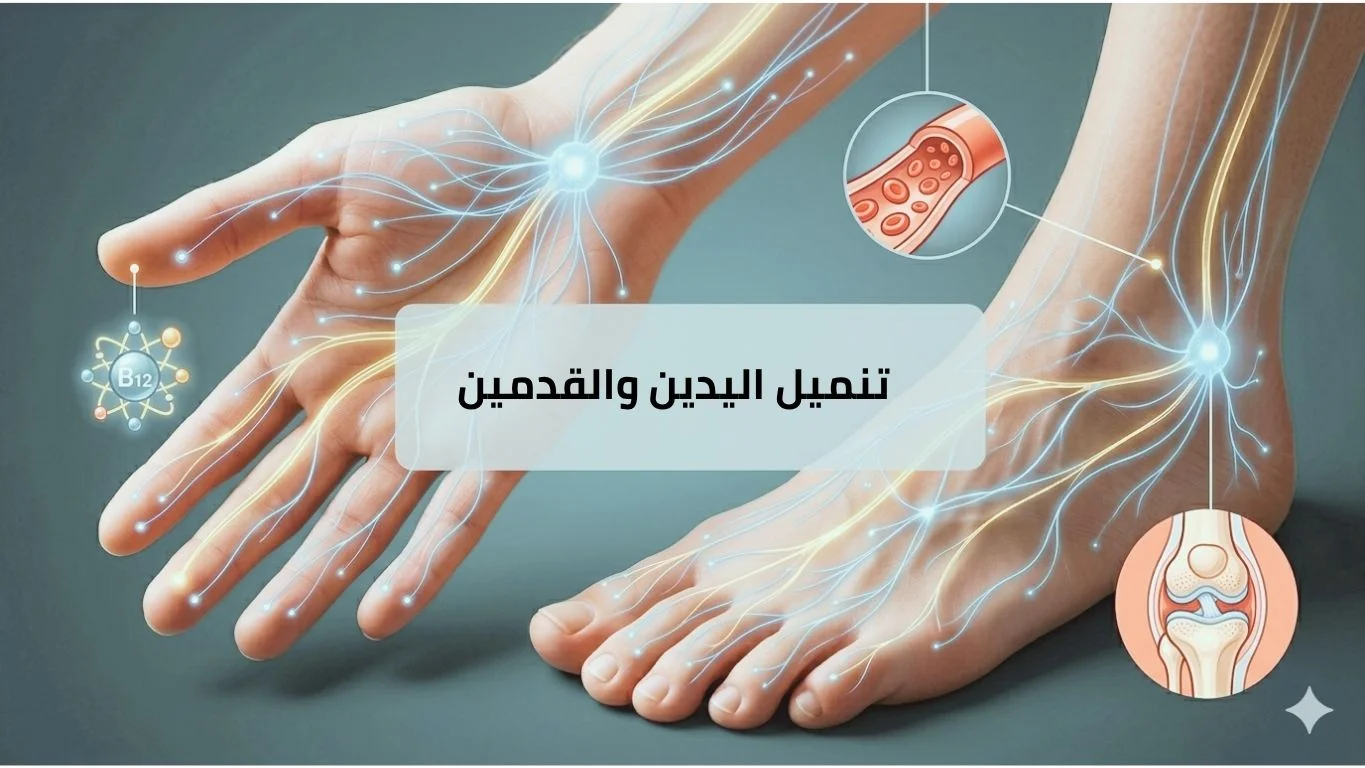
What is the difference between positional tingling and nerve damage?
Not all tingling is the same. The critical clinical distinction is between mechanical nerve compression and systemic nerve dysfunction:
Positional (benign)
- • Caused by external pressure on a nerve trunk
- • Resolves within seconds to minutes after repositioning
- • Unilateral — affects only the compressed limb
- • No progression over time
- • Common examples: sitting on your leg, sleeping on your arm
Pathological (investigate)
- • No positional trigger — occurs at rest
- • Stocking-glove distribution: starts in toes/fingertips, progresses proximally
- • Bilateral and symmetrical
- • Worsens over weeks/months
- • May be accompanied by weakness, pain, or loss of coordination
The stocking-glove pattern — where symptoms begin in the extremities farthest from the spinal cord — is the hallmark of length-dependent peripheral neuropathy. The longest nerve fibres are affected first because they require the most myelin maintenance.
How does B12 deficiency cause tingling and numbness?
The methionine synthase → SAMe → myelin pathway
Vitamin B12 (as methylcobalamin) serves as the essential cofactor for methionine synthase, the enzyme that converts homocysteine to methionine. Methionine is then adenylated to form S-adenosylmethionine (SAMe) — the universal methyl donor.
SAMe provides the methyl groups needed for phosphatidylcholine synthesis, the primary lipid component of the myelin sheath. Schwann cells in the peripheral nervous system use this pathway to maintain myelin integrity. When B12 is deficient → methionine synthase stalls → SAMe drops → phosphatidylcholine production fails → myelin degrades → nerve conduction velocity slows → you feel tingling.
Vitamin B12 (Methylcobalamin)
- Cofactor for methionine synthase → SAMe production
- SAMe → phosphatidylcholine → myelin sheath maintenance
- Higher retention in nerve tissue vs cyanocobalamin (Watanabe 1994)
- Deficiency → demyelination → slowed NCV → tingling/numbness
Vitamin B1 (Benfotiamine)
- Bypasses THTR-1/THTR-2 transporters via passive lipid membrane diffusion
- Activates transketolase in the pentose phosphate pathway → NADPH for nerve energy
- Inhibits AGE formation — reduces glycation-driven nerve damage
- Standard thiamine (water-soluble) has low bioavailability — THTR saturation limits uptake
Who is most at risk for B-vitamin-related neuropathy?
Certain populations have higher rates of B12 and B1 deficiency — and therefore higher risk for the peripheral nerve symptoms described above:
Vegetarian or Vegan Diet
B12 is found almost exclusively in animal products. Without supplementation, vegans reach deficiency within 2–5 years as hepatic B12 stores deplete (Pawlak et al., 2013)
Metformin Use (Diabetes)
Metformin reduces B12 absorption by 10–30% by interfering with the calcium-dependent ileal uptake of the B12-intrinsic factor complex. Long-term users should monitor B12 levels
MTHFR Polymorphisms
~30–40% of the population carries MTHFR variants that reduce methylation efficiency. These individuals may convert cyanocobalamin poorly, making methylcobalamin supplementation more appropriate
Age Over 50
Gastric atrophy reduces intrinsic factor and acid secretion, impairing B12 release from food protein. Up to 20% of adults over 60 have subclinical B12 deficiency (Allen, 2009)
What are active B vitamin forms and why do they matter for nerve symptoms?
Standard B vitamin forms require enzymatic conversion before they can participate in nerve-relevant biochemistry. Active forms bypass these conversion steps:
| Vitamin | Standard Form | Active Form | Why Active Matters for Nerves |
|---|---|---|---|
| B12 | Cyanocobalamin | Methylcobalamin | Skips MMACHC decyanation + reductase conversion; enters methionine synthase → SAMe pathway directly |
| B1 | Thiamine HCl | Benfotiamine | Bypasses saturable THTR-1/THTR-2 transporters via passive lipid diffusion; achieves 5× higher plasma levels |
| B6 | Pyridoxine HCl | P-5-P (Pyridoxal-5-phosphate) | Skips the rate-limiting pyridoxal kinase step in the liver; directly available for neurotransmitter synthesis |
Frequently Asked Questions
Read Also
How to distinguish benign compression from length-dependent neuropathy
Vitamin B12 and Tingling — The SAMe Pathway ConnectionHow B12 deficiency disrupts methionine synthase and myelin maintenance
Methylcobalamin for Nerves — Schwann Cell Biology & Retention DataWhy the active form matters for nerve tissue specifically