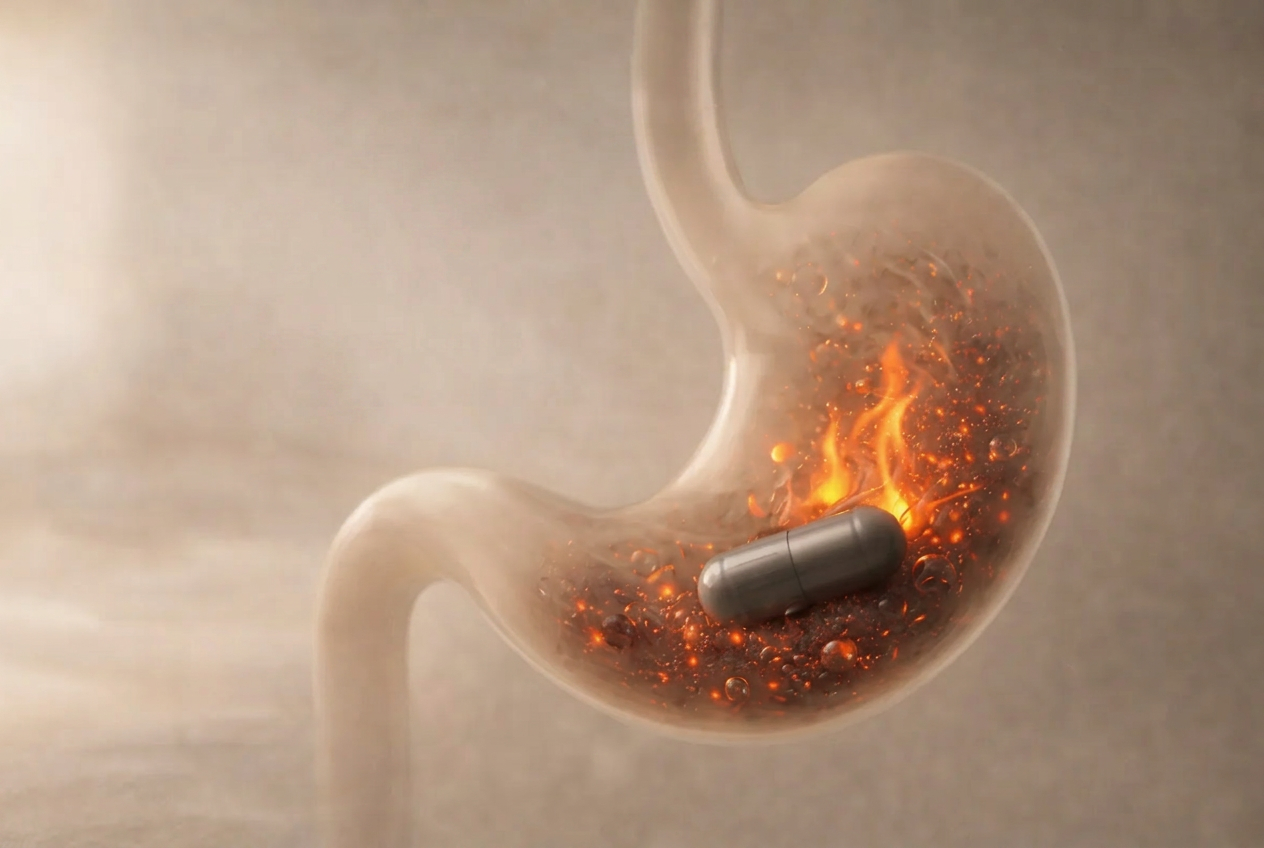
When people say "iron hurts my stomach," what do they usually mean?
In most cases, this does not refer to one single symptom.
It usually describes any uncomfortable experience with iron that makes daily use feel difficult.
That may include things like:
- Nausea within 15–45 minutes — caused by free Fe²⁺ ions triggering Fenton-reaction oxidative damage on the gastric mucosa, activating vagal afferent nerve signals to the brainstem's area postrema
- Epigastric burning or 'brick in stomach' sensation — prostaglandin E2 (PGE₂) release from iron-damaged mucosal cells, the same inflammatory pathway triggered by NSAIDs
- Metallic taste — free Fe²⁺ ions reaching taste receptors via retrograde diffusion from the stomach, not a flavour in the tablet itself
- Constipation (delayed onset, 12–48 hours) — unabsorbed iron reaching the colon, altering the microbiome balance and reducing Lactobacillus populations
- Difficulty staying consistent — the cumulative effect of daily mucosal irritation leading to supplement abandonment, the most common reason for treatment failure in iron deficiency
So when someone searches for gentle iron on the stomach, she may sometimes mean nausea, sometimes heaviness, sometimes constipation, and sometimes simply a type she can continue with more comfortably.
Quick symptom map: the most common forms of iron tolerability issues
Why do some iron types feel harder on the stomach than others?
The short answer: it depends on whether the iron compound releases free reactive ions in your stomach or stays chemically bound until absorption. This is a molecular-level difference with real-world consequences for nausea, constipation, and daily consistency.
Each child page below covers a specific aspect of this chemistry in depth:
The key principle across all of these: the iron element is identical in every supplement. The carrier molecule — salt vs chelate — determines the side-effect profile. Chelated forms like ferrous bisglycinate keep the iron bound through the stomach, preventing the free-ion reactions that cause both acute gastric symptoms and delayed colonic symptoms.
When does switching the iron form matter most?
Not everyone needs to switch. If your current iron type causes no discomfort, changing the form offers no additional clinical benefit — the iron element is the same regardless of the carrier molecule.
Switching becomes clinically relevant when:
- You have discontinued iron due to GI side effects — the most common reason for non-adherence in iron deficiency treatment
- Nausea or epigastric discomfort occurs within 30–60 minutes of dosing (suggesting mucosal irritation from free-ion release)
- Constipation developed after starting iron and resolved when you stopped
- You are pregnant and first-trimester nausea compounds iron-related GI distress
- You have a pre-existing sensitive stomach (IBS, gastritis, or GERD) that amplifies mucosal reactions to free iron ions
In these scenarios, the question is not whether you need iron — your doctor has likely confirmed that. The question is whether the delivery mechanism of your current supplement is compatible with your GI tolerance threshold.
If tolerability during pregnancy is your primary concern: Gentler Iron During Pregnancy →
How Hemascore applies the chelation principle
Hemascore uses ferrous bisglycinate as its iron source — the chelated form described above. The iron remains bound to its glycine carrier through the stomach, reducing free-ion exposure to the gastric mucosa and utilising PepT1 peptide transport for absorption.
It also includes Vitamin C (which enhances non-heme iron absorption by reducing Fe³⁺ to Fe²⁺ at the point of uptake, not in the stomach) and folic acid — relevant for women with concurrent folate needs during pregnancy or heavy menstruation.
This combination addresses the two most common reasons women stop iron supplements: GI discomfort from the iron form, and suboptimal absorption requiring higher doses that further compound tolerability issues.
Hemascore is not appropriate for all iron deficiency cases. Severe deficiency, malabsorption disorders, or conditions requiring IV iron need medical-directed treatment. If your symptoms are mild and your current supplement causes no discomfort, there may be no clinical reason to switch.
This page explains how iron chemistry affects tolerability. It does not replace medical evaluation. If you have severe symptoms, a specific health condition, or need an accurate assessment of your iron status, consult your doctor.