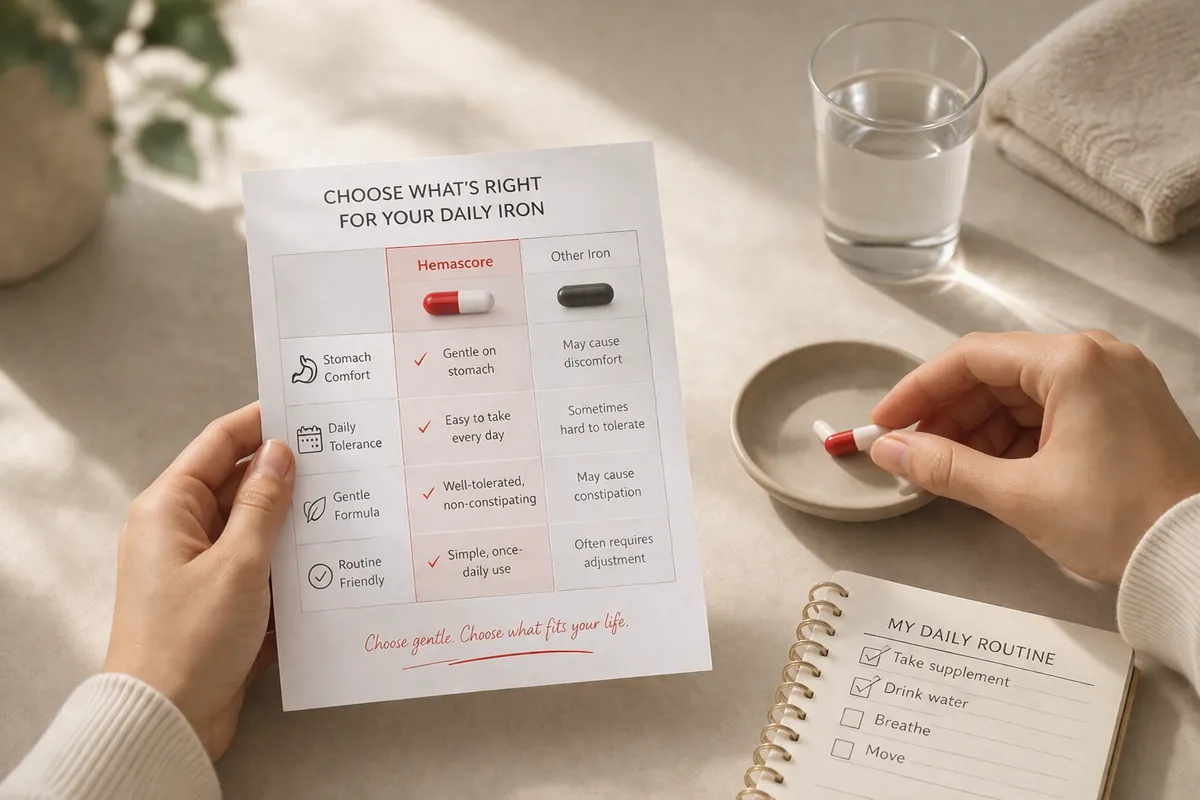
Quick Summary
- Gentle iron's tolerability comes from reduced Fenton reaction activity in the GI tract.
- Bisglycinate's PepT1 absorption pathway means less free Fe²⁺ sits in the intestinal lumen.
- Hepcidin's 24-hour cycle means single daily dosing may actually improve absorption efficiency.
- Enterocyte iron loading from high-dose sulfate triggers mucosal block — gentle iron avoids this.
Every article about "gentle iron" explains chelation. Very few explain why chelation works at the cellular level — or why your body actively fights iron absorption after the first dose of the day.
The real science of iron tolerability involves three systems that most supplement content ignores: the hepcidin regulatory axis (your body's iron gatekeeper), the enterocyte lifecycle (the 3–5 day turnover of absorptive cells), and the mucosal block phenomenon (why your gut refuses iron after a large dose).
Understanding these mechanisms changes how you think about iron supplementation — not just which form to choose, but when to take it, how much to take, and why more is often worse.
What is hepcidin and how does it control iron absorption?
Hepcidin is a 25-amino-acid peptide hormone produced primarily by hepatocytes. It is the master regulator of systemic iron homeostasis — and it directly determines how much iron your gut can actually absorb from any given dose.
How the hepcidin feedback loop works
When you take an iron supplement, the absorbed iron enters the bloodstream and triggers the BMP-SMAD signalling pathway in the liver. This pathway upregulates hepcidin synthesis. Hepcidin then circulates to the intestine and binds to ferroportin — the only known iron export channel on the basolateral membrane of enterocytes.
When hepcidin binds ferroportin, it triggers ferroportin internalisation and degradation. The result: iron that has been absorbed into enterocytes cannot be exported into the bloodstream. It remains trapped inside the enterocyte until that cell is shed into the gut lumen during normal mucosal turnover (every 3–5 days).
The timing problem: Hepcidin levels rise within 6–8 hours of an iron dose and remain elevated for approximately 24 hours (Moretti et al. 2015). This means a second dose taken the same day encounters a partially closed gate — absorption efficiency drops to approximately 35–45% of the first dose (Stoffel et al. 2017).
This is why alternate-day dosing has shown comparable haemoglobin outcomes to daily dosing in recent trials: by waiting 48 hours between doses, hepcidin returns to baseline and ferroportin is fully available for iron export.
Why does iron absorption decrease after the first dose?
Iron absorption does not happen across a static membrane. It happens through enterocytes — specialised absorptive cells in the duodenal and upper jejunal epithelium. These cells have a lifespan of only 3–5 days before they are shed into the gut lumen and replaced by new cells migrating up from the crypts of Lieberkühn.
The mucosal block phenomenon
In the 1940s, Hahn and colleagues observed that a large oral iron dose temporarily blocked absorption of subsequent doses — even when given hours later. This was termed the "mucosal block" and was initially poorly understood.
We now know the mechanism: when an enterocyte absorbs iron, it stores the excess as ferritin within its cytoplasm. If hepcidin prevents ferroportin-mediated export, this ferritin-bound iron accumulates. The enterocyte effectively becomes "full" — its DMT1 transporters downregulate, and no further iron can enter from the lumen.
The block resolves only when the iron-loaded enterocyte is shed (carrying its trapped iron with it) and replaced by a fresh, iron-naive cell from the crypt. This takes 3–5 days.
Clinical implication: Taking 60+ mg of elemental ionic iron in a single dose overwhelms the available enterocyte pool. The excess iron that cannot be absorbed passes into the colon as free Fe²⁺ — where it catalyses Fenton reactions, disrupts microbiota, and causes the constipation and nausea patients report. The side effects are a direct consequence of exceeding absorptive capacity.
How does chelated iron (ferrous bisglycinate) improve absorption and tolerability?
Most "gentle iron" content explains chelation as "the iron is wrapped in amino acids." That is a simplification. The real advantage of chelated forms like ferrous bisglycinate operates at three distinct levels:
1Dual-pathway absorption reduces DMT1 saturation
Ionic iron salts rely exclusively on the DMT1 transporter — a saturable channel shared with other divalent metals (zinc, manganese, copper). Ferrous bisglycinate can also be absorbed through the PepT1 peptide transporter, which treats the chelated complex as a dipeptide. This dual-pathway access means more iron is absorbed before DMT1 saturates, reducing the fraction that spills into the colon.
2Lower hepcidin spike per unit absorbed
Because chelated iron is absorbed more efficiently at lower doses, the total serum iron spike — and therefore the hepcidin response — can be moderated. A 25 mg chelated dose that achieves 30% absorption delivers ~7.5 mg to the bloodstream, triggering a proportionally smaller hepcidin response than a 65 mg sulfate dose at 10% absorption (also ~6.5 mg, but with far more colonic exposure).
3Less enterocyte ferritin loading
When iron enters the enterocyte via PepT1 as an intact chelate rather than as free Fe²⁺ via DMT1, the intracellular processing differs. The chelated complex may be handled through different trafficking pathways, potentially reducing the ferritin-loading that triggers the mucosal block. This remains an area of active research (Ashmead 2001; Pineda & Ashmead 2001).
The net result: chelated iron achieves higher fractional absorption, produces fewer colonic free ions, and may trigger less aggressive hepcidin-mediated shutdown — addressing all three bottlenecks simultaneously.
Why do some people tolerate iron supplements while others cannot?
Even with the same iron form and dose, tolerability differs between people. This is not random — it reflects measurable physiological variables:
Gastric pH
Iron salt dissociation rate depends on gastric acidity. Patients on PPIs (proton pump inhibitors) or H2 blockers have higher gastric pH, which paradoxically may reduce free-ion release from sulfate forms — but also reduces overall absorption, meaning more iron reaches the colon unabsorbed.
DMT1 transporter expression
DMT1 density in the duodenal brush border is regulated by iron status (via IRE/IRP system). Iron-deficient individuals upregulate DMT1, absorbing more iron per dose — but also experiencing more intracellular iron loading per enterocyte if the dose exceeds export capacity.
Gut microbiota composition
Individuals with higher baseline Lactobacillus and Bifidobacterium populations may be more resilient to the dysbiosis caused by colonic free iron (Zimmermann et al. 2010). Those with pre-existing dysbiosis may experience disproportionate GI symptoms even at moderate iron doses.
Hormonal status
Progesterone (elevated in pregnancy and the luteal phase) slows GI motility by 30–50%. This extends the transit time of unabsorbed iron through the colon, amplifying oxidative exposure. Women in their third trimester or luteal phase may experience iron-related constipation more acutely than the same individual at other times.
What is the best dosing strategy for iron supplements?
If you understand hepcidin timing, enterocyte cycling, and DMT1 saturation, the optimal dosing strategy becomes clear:
| Strategy | Rationale | Evidence |
|---|---|---|
| Single daily dose | Avoids competing with elevated hepcidin from a prior dose | Moretti et al. 2015 |
| Alternate-day dosing | Allows full hepcidin reset (24–48h); comparable Hb outcomes | Stoffel et al. 2017 |
| Lower elemental dose | Reduces DMT1 saturation and colonic spillover | Mechanistic (DMT1 kinetics) |
| Chelated form | PepT1 pathway provides additional absorption capacity | Pineda & Ashmead 2001 |
| With Vitamin C, without calcium | Ascorbic acid enhances Fe³⁺→Fe²⁺ reduction; calcium competes for absorption | Hallberg et al. 1989 |
The combination of these strategies — lower dose, chelated form, once daily or alternate-day, with Vitamin C — maximises the ratio of absorbed iron to colonic iron. That ratio is what "gentle" actually means in pharmacokinetic terms.
How to choose a gentle iron supplement based on the science
The decision between iron forms is not a marketing question. It is a pharmacokinetic one. Based on the mechanisms above, a well-designed iron supplement should:
- Use a chelated form to access both DMT1 and PepT1 pathways, reducing saturation-driven spillover
- Provide a moderate elemental iron dose (25–36 mg) rather than maximising per-tablet content
- Include Vitamin C to enhance Fe³⁺→Fe²⁺ conversion at the enterocyte surface
- Be formulated for once-daily dosing to avoid hepcidin-mediated absorption suppression
- Avoid fillers or additives that alter gastric pH or compete for transporter binding
Hemascore was designed around exactly these principles — ferrous bisglycinate at 36 mg elemental iron, with Vitamin C for absorption enhancement, and active B-vitamin cofactors (P5P, Methylcobalamin, 5-MTHF) for downstream erythropoiesis. The formulation logic is a direct application of the hepcidin-enterocyte-chelation framework described in this article.
When to discuss iron form with your doctor
Iron form selection should be discussed with a healthcare professional if:
- You have discontinued iron previously due to GI side effects — the Fenton mechanism explains why, and chelated forms may bypass it
- You are taking PPIs or calcium supplements — these alter gastric pH and compete for absorption, increasing colonic iron burden regardless of form
- You are pregnant — progesterone-mediated motility reduction amplifies colonic oxidative exposure from unabsorbed iron
- You have IBD, coeliac disease, or chronic gastritis — mucosal integrity affects DMT1 expression and absorption capacity
- Your ferritin is <15 μg/L or haemoglobin <10 g/dL — severe deficiency may require IV iron, bypassing the enterocyte bottleneck entirely
Do not self-prescribe iron for suspected deficiency. A serum ferritin test and complete blood count (CBC) are the minimum diagnostic baseline before starting supplementation.