Quick Summary
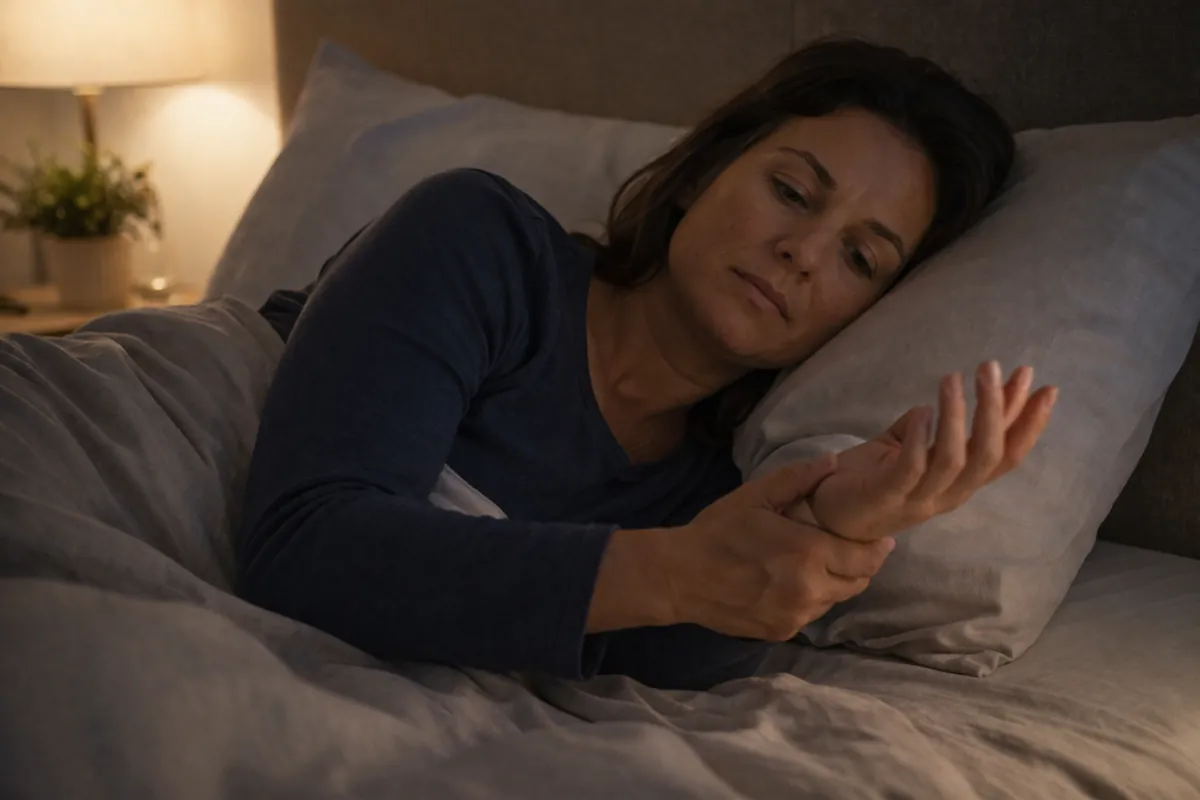
- Tingling during sleep is often positional neurapraxia — nerve compression from sleeping posture.
- Positional tingling resolves within 1-2 minutes of moving; pathological tingling persists longer.
- Carpal tunnel syndrome commonly causes nocturnal tingling in the first 3 fingers due to wrist flexion during sleep.
- If nocturnal tingling is nightly, bilateral, and progressive, investigate B12 and blood glucose levels.
Quick Answer: Three Categories of Nocturnal Tingling
| Category | Key Features | Action Needed |
|---|---|---|
| Positional neurapraxia | Any nerve; resolves in <2 min; no fixed distribution | None — change position |
| Entrapment neuropathy | Fixed nerve distribution (median, ulnar); reproducible; progressive | Provocation tests → NCS if positive |
| Systemic neuropathy | Symmetric glove-and-stocking; persistent day & night; burning feet | Blood tests (B12, MMA, HbA1c) → NCS |
Why Tingling Is More Common at Night: The Neurophysiology
Sleep creates the perfect conditions for nerve compression. During sleep, the body remains in a single position for hours without the constant micro-adjustments that occur while awake. This produces sustained pressure at vulnerable anatomical points:
- Ulnar nerve at the elbow: Sleeping with a flexed elbow stretches the ulnar nerve over the medial epicondyle and reduces the cubital tunnel volume by ~55%. This is the most common cause of waking up with ring and little finger tingling
- Median nerve at the wrist: During sleep, the wrist naturally flexes. Each degree of wrist flexion increases carpal tunnel pressure — at 90° flexion, intra-tunnel pressure rises from the normal 2.5 mmHg to 30+ mmHg, sufficient to block nerve conduction
- Radial nerve against the humerus: Sleeping with the arm draped over a chair back or partner ('Saturday night palsy') compresses the radial nerve in the spiral groove, causing wrist drop and dorsal hand numbness
- Peroneal nerve at the fibular head: Side-sleeping with legs stacked compresses the common peroneal nerve, causing top-of-foot numbness and potentially foot drop
Additionally, patients with existing neuropathy (metabolic, inflammatory) often report worsened symptoms at night. This is not because the neuropathy itself is worse at night, but because reduced sensory input during rest removes masking signals, making existing nerve dysfunction more noticeable
Category 1: Positional Neurapraxia (Harmless)
Neurapraxia is a temporary conduction block caused by focal compression of the myelin sheath. The nerve is not damaged — conduction simply stalls until pressure is removed. This is the mechanism behind the common "arm fell asleep" experience
Diagnostic features
- Variable nerve distribution — different nerve affected on different nights depending on position
- Resolution within 1–2 minutes of repositioning and limb movement
- No residual weakness, no persistent numbness, no reflex changes
- No daytime symptoms
- No progressive worsening over time
No diagnostic testing required. If episodes are frequent, simple position modification (avoid sleeping on the arm, use a body pillow between the knees) is sufficient
Category 2: Carpal Tunnel Syndrome — The Most Common Pathological Cause
Carpal tunnel syndrome (CTS) is the most common entrapment neuropathy and the most common pathological cause of nocturnal hand tingling. It occurs when the median nerve is compressed within the rigid carpal tunnel at the wrist
Why it is worse at night
During sleep, the wrist naturally flexes, which reduces carpal tunnel cross-sectional area by up to 50%. Additionally, nocturnal fluid redistribution (lying supine increases peripheral oedema) raises intraneural pressure within the already-tight tunnel
Diagnostic distribution
The median nerve supplies sensation to a very specific territory: thumb, index finger, middle finger, and the radial (thumb-side) half of the ring finger. If nighttime tingling consistently affects these fingers, carpal tunnel is the primary suspect
Provocation tests you can try
- Phalen's test: Hold both wrists in maximum flexion (backs of hands pressed together) for 60 seconds. If your typical tingling symptoms reproduce in the median nerve distribution, the test is positive. Sensitivity ~68%, specificity ~73%
- Reverse Phalen's (prayer test): Hold both wrists in maximum extension (palms pressed together) for 60 seconds. Positive if symptoms reproduce
- Tinel's sign: Tap firmly over the carpal tunnel at the wrist crease. Positive if electric tingling shoots into the thumb, index, or middle finger. Sensitivity ~50%, specificity ~77%
- Durkan's test (carpal compression): Apply direct pressure over the carpal tunnel with both thumbs for 30 seconds. Positive if symptoms reproduce. Sensitivity ~87% — the most sensitive clinical test
- Flick sign: Patients instinctively shake their hand upon waking to relieve symptoms — if present, sensitivity for CTS is 93%
NCS confirmation
Nerve conduction studies are the gold standard for CTS diagnosis. Key findings:
- Prolonged median sensory distal latency >3.5 ms (mild CTS)
- Prolonged median motor distal latency >4.2 ms (moderate CTS)
- Reduced SNAP amplitude (severe CTS — indicates axonal loss)
- Comparison with ulnar nerve values in the same hand (the median-ulnar latency difference is the most sensitive electrodiagnostic measure)
Treatment ladder
- First-line: Nocturnal wrist splinting in neutral position (0–5° extension) — evidence grade A. Most patients improve within 4–6 weeks
- Activity modification: Avoid sustained wrist flexion/extension during the day
- Corticosteroid injection: Provides temporary relief (weeks to months); useful diagnostically — if injection relieves symptoms, CTS diagnosis is confirmed
- Surgical release: Indicated for persistent symptoms despite conservative treatment, thenar weakness, or NCS showing axonal loss (reduced SNAP amplitude)
Cubital Tunnel Syndrome: The Other Common Nocturnal Entrapment
The second most common entrapment neuropathy, cubital tunnel syndrome affects the ulnar nerve at the elbow. It is extremely common in people who sleep with their elbows bent beyond 90°
- Distribution: Ring finger and little finger; medial hand and forearm
- Night-specific: Sleeping with elbows bent stretches the ulnar nerve and reduces cubital tunnel volume. Patients often wake with ring/little finger numbness
- Provocation: Elbow flexion test — hold elbows in full flexion with wrists extended for 60 seconds. Positive if tingling reproduces in the ulnar distribution
- Late sign: Intrinsic hand muscle weakness — difficulty spreading fingers, weakened grip, Froment's sign (compensatory thumb IP flexion during pinch grip)
- Conservative treatment: Elbow padding at night, avoiding sustained elbow flexion, towel wrap around the elbow to prevent full flexion during sleep
Category 3: Systemic Neuropathy Unmasked at Night
When tingling is present throughout the day but becomes more noticeable at night, the issue is typically a pre-existing neuropathy that nocturnal quiet and positional compression amplify
Key distinguishing features from positional/entrapment causes
- Symptoms present during the day as well — not only nocturnal
- Symmetric glove-and-stocking distribution — both feet, then both hands
- Burning quality rather than pins-and-needles
- Reduced vibration sense at the great toe (test with 128Hz tuning fork)
- Absent or reduced ankle reflexes
- Progressive worsening over weeks to months
Common systemic causes of nocturnal-predominant neuropathy
- B12 deficiency: Serum B12 <200 pg/mL or elevated MMA >0.4 μmol/L. B12 is cofactor for methionine synthase → SAMe → myelin synthesis. Deficiency causes dorsal column and peripheral nerve demyelination
- Diabetic neuropathy: HbA1c ≥6.5%. Polyol pathway activation, AGE formation, and oxidative stress damage small and large fibres. Night-time burning feet is a classic presentation
- Hypothyroidism: TSH elevation. Myxoedematous tissue swelling narrows anatomical tunnels (increases CTS risk 2–3×) and slows nerve conduction velocity
- Chronic kidney disease: Uraemic neuropathy from accumulated neurotoxic metabolites
First-line blood tests when systemic neuropathy is suspected: serum B12, methylmalonic acid (MMA), homocysteine, HbA1c, fasting glucose, TSH, complete blood count, renal function (eGFR, creatinine)
Red Flags: When Nocturnal Tingling Needs Urgent Evaluation
Seek emergency evaluation if nocturnal tingling is accompanied by:
- • Chest pain or shortness of breath (cardiac evaluation)
- • Sudden unilateral weakness or facial drooping (stroke)
- • Rapidly ascending weakness over hours (Guillain-Barré syndrome)
- • Sudden loss of bladder/bowel control with bilateral leg symptoms (cauda equina)
Non-emergency referral indicators: persistent thenar wasting (CTS — may need surgical release), progressive bilateral sensory loss, or failure to improve after 6 weeks of conservative measures
Conclusion
Nocturnal tingling falls into three clear categories: transient positional compression (most common, harmless), focal entrapment neuropathy (carpal tunnel, cubital tunnel — testable with provocation tests), and systemic neuropathy unmasked at night (B12, diabetes — requires blood testing and NCS)
The diagnostic key is pattern recognition: which fingers are affected, how quickly symptoms resolve, whether they are reproducible, and whether daytime symptoms coexist
For a comprehensive ranked differential diagnosis of all tingling causes, see Top 7 Causes of Tingling in Hands and Feet. For distinguishing nerve from vascular causes, see Is Numbness from Nerves or Circulation?