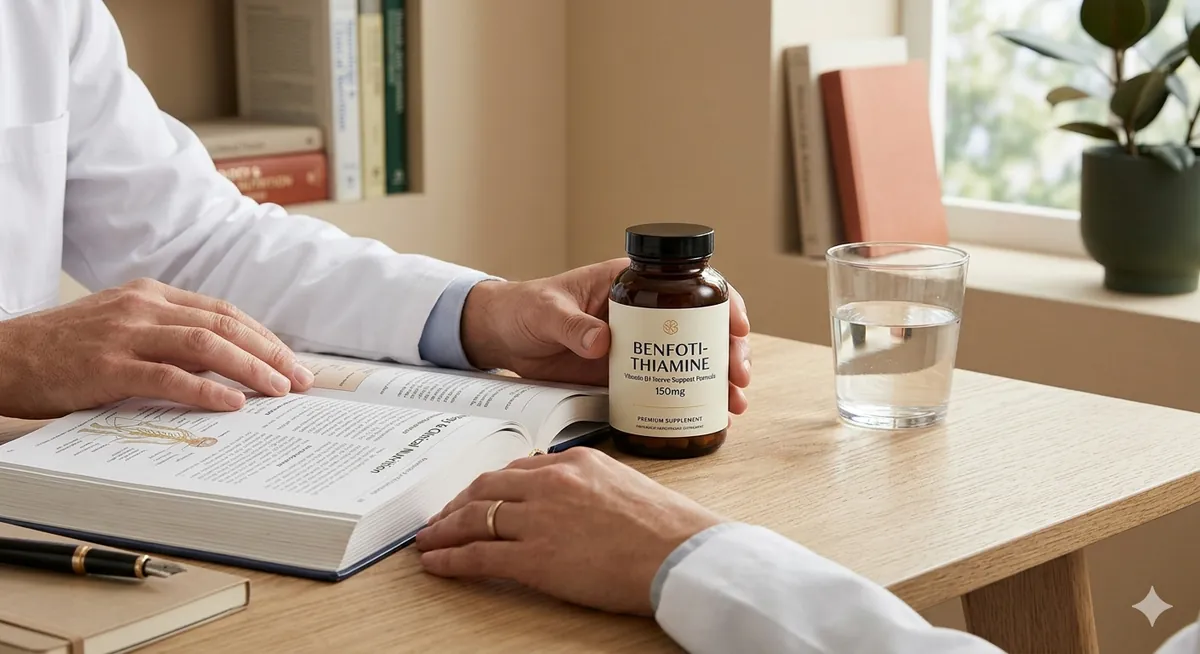
Quick Summary
- Benfotiamine is a lipid-soluble B1 derivative that bypasses intestinal THTR-1/THTR-2 transporter saturation.
- It activates transketolase in the pentose phosphate pathway, diverting sugar metabolites away from AGE formation.
- AGE (Advanced Glycation End-products) inhibition protects nerve proteins from glycation-induced damage.
- Bioavailability is 3.6× higher than thiamine HCl at equivalent doses.
The absorption problem with standard B1: THTR-1 and THTR-2 saturation
Standard thiamine (thiamine HCl, thiamine mononitrate) is water-soluble and relies on two active transporters for intestinal absorption and cellular uptake:
- THTR-1 (SLC19A2) — primary thiamine transporter in intestinal epithelium and most tissues
- THTR-2 (SLC19A3) — secondary transporter, particularly important in neural tissue
Both are saturable active transporters — they have a maximum transport capacity (Km). Above this threshold, additional oral thiamine simply passes through the GI tract unabsorbed. This creates a ceiling on how much intracellular thiamine you can achieve with water-soluble B1, regardless of dose.
The limitation: A patient taking 100 mg of thiamine HCl does not get 10× the intracellular thiamine of someone taking 10 mg. THTR-1/THTR-2 saturation means most of the excess dose is excreted unchanged in urine. For nerve tissue — where thiamine demand is high and continuous — this creates a bottleneck that higher doses cannot overcome.
How Benfotiamine bypasses the THTR bottleneck
Benfotiamine belongs to a class of compounds called allithiamines — thiamine derivatives with an open thiazole ring and a lipophilic side chain. This lipid-soluble structure allows Benfotiamine to cross cell membranes via passive diffusion through the lipid bilayer, completely bypassing the THTR-1 and THTR-2 transporters.
The Schreeb data: 5× higher intracellular levels
Schreeb et al. (1997) compared plasma and intracellular thiamine levels after equimolar doses of Benfotiamine vs thiamine HCl. Benfotiamine achieved approximately 5× higher intracellular thiamine concentrations — not because it is "better absorbed" in the conventional sense, but because it uses a fundamentally different entry mechanism that is not subject to transporter saturation.
Mechanism: Benfotiamine → intestinal absorption (lipid diffusion) → dephosphorylation to S-benzoylthiamine in enterocytes → conversion to free thiamine in the bloodstream → cellular uptake via lipid diffusion (bypassing THTR again) → phosphorylation to thiamine pyrophosphate (TPP) — the biologically active cofactor.
Transketolase activation: the primary nerve-protective mechanism
Inside the cell, the elevated TPP from Benfotiamine activates transketolase — the rate-limiting enzyme in the non-oxidative branch of the pentose phosphate pathway (PPP).
Why transketolase activation protects nerves
In hyperglycaemic or metabolically stressed conditions, excess glycolytic intermediates (fructose-6-phosphate and glyceraldehyde-3-phosphate) accumulate. These intermediates feed into three damaging pathways:
1. The hexosamine pathway
Excess fructose-6-phosphate is converted to UDP-N-acetylglucosamine, which modifies intracellular proteins and disrupts normal cell signalling in nerve tissue.
2. The PKC (protein kinase C) pathway
Excess glyceraldehyde-3-phosphate is converted to diacylglycerol (DAG), which activates PKC isoforms. PKC activation increases vascular permeability, reduces blood flow to nerve tissue, and promotes inflammatory signalling.
3. The AGE (advanced glycation end-product) pathway
Glycolytic intermediates react non-enzymatically with proteins, forming AGEs. AGEs bind to RAGE receptors on nerve cells, triggering NF-κB-mediated inflammatory cascades and oxidative stress — a primary mechanism of diabetic neuropathy.
Transketolase diverts these glycolytic intermediates into the pentose phosphate pathway, converting them to ribose-5-phosphate (for nucleotide synthesis) and other non-toxic metabolites. By activating transketolase, Benfotiamine simultaneously blocks all three damaging pathways — hexosamine, PKC, and AGE formation.
Clinical evidence: BEDIP and Stracke trials
BEDIP study (Winkler et al. 2005)
The Benfotiamine in Diabetic Polyneuropathy (BEDIP) study treated diabetic neuropathy patients with Benfotiamine 400 mg/day for 3 weeks. Results showed statistically significant improvement in neuropathy symptom scores compared to placebo, particularly for pain and vibration perception threshold. The study confirmed that Benfotiamine's transketolase activation translates to measurable clinical improvement, not just biochemical markers.
Stracke et al. (1996, 1999)
Stracke's studies evaluated Benfotiamine-containing B-vitamin combinations in diabetic patients with polyneuropathy. Results showed improvements in nerve conduction velocity (NCV) — a direct measure of nerve fibre function. The combination of Benfotiamine with B6 and B12 produced greater improvements than any single B vitamin, supporting the multi-pathway approach to nerve support.
Evidence context: The strongest clinical data for Benfotiamine comes from diabetic peripheral neuropathy. For non-diabetic neuropathy, the transketolase activation and AGE-inhibition mechanisms are pharmacologically relevant, but direct RCT data is more limited. The BEDIP and Stracke trials remain the benchmark references.
Benfotiamine vs standard B1: the comparison that matters
| Property | Thiamine HCl (standard B1) | Benfotiamine |
|---|---|---|
| Absorption | THTR-1/THTR-2 (saturable) | Passive lipid diffusion (unsaturable) |
| Intracellular levels | Dose-limited by THTR capacity | ~5× higher (Schreeb 1997) |
| Transketolase activation | Limited by intracellular TPP ceiling | Significantly enhanced |
| AGE inhibition | Minimal at achievable intracellular levels | Demonstrated in vitro and in vivo |
| Clinical neuropathy data | Limited | BEDIP (Winkler 2005), Stracke (1996, 1999) |
The comparison is not "better vs worse" — it is "different pharmacokinetic mechanism." Benfotiamine accesses intracellular compartments that standard B1 cannot reach at oral doses, which is why nerve-specific formulas increasingly specify Benfotiamine rather than generic thiamine.
Why nerve formulas combine Benfotiamine with other active B vitamins
Benfotiamine handles the energy and protection arm of nerve health — transketolase activation, AGE inhibition, and axonal energy substrate provision. But peripheral nerves also require:
- Methylcobalamin (active B12) — cofactor for methionine synthase → SAMe → myelin phospholipid synthesis in Schwann cells
- P-5-P (active B6) — cofactor for GABA, serotonin, and dopamine neurotransmitter synthesis
- 5-MTHF (active folate) — provides methyl groups for the one-carbon metabolism cycle that intersects with B12's methylation pathway
This is why Cobascore combines all four active B vitamins — each addresses a distinct biochemical arm of nerve maintenance. Removing any one creates a gap that the others cannot compensate for.